What is LEX ?
Lex is a tool which generates LEXERS which are also known as Lexical Analyzers.
Lexical Analyzer converts source program to tokens.
LEX is a character input/output stream lexical processing programme generator. From a simple text search programme that looks for patterns in its input-output file to a C compiler that converts a programme into optimised code.
LEX file is saved with .l extenstion
Structure of a LEX File
Structure of LEX is divided into 3 types
1. Specification/ Declarations
2. Recognition and Actions
3. Miscallenous Function
1. Specifications/ Declartions:
This Section Defines macro instructions and import header files which are written in C. It is also possible to write any C code here, which will be copied same into the generated source file.
2. Recognition and Actions:
This section basically associates regular expression patterns with C statements.
This is in the form of
P1{action 1}
P2{action 2}
P3{action 3}
——Pn{action n}
{action i} defines the action to be performed when Pi pattern is recognized.
3. Miscallenous Functions:
This sections contains C statements and functions that are copied exactly into the generated source file.
Without LEX
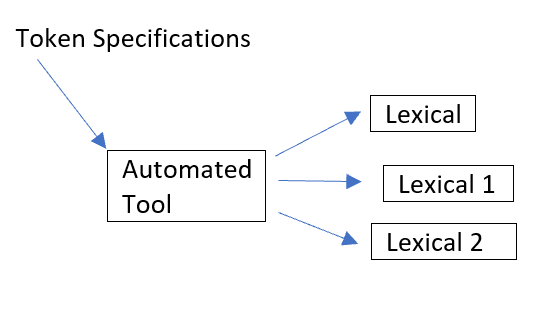
Lexical, Lexical1, Lexical2 ——- Lexical N can be any programming file. For convenience we didn’t mention any file extension.
With LEX
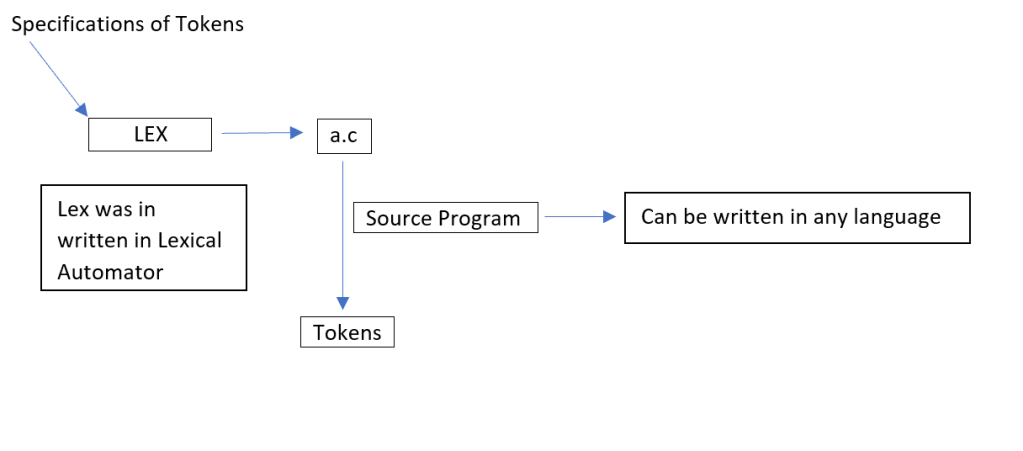
Format of LEX:
%% Specifications
%% Recognition and Actions
%% Functions or Miscellaneous Functions
Example of LEX Program:
/*** Definition section ***/
%{
#include <stdio.h>
%}
/*** Rules Section***/
digit[0-9]+
%%
/*** Recognition and Actions***/
digit{printf("%d is a number\n");}
%%
/*** C code sections or Miscellaneous Functions***/
int main()
{
    yylex(); /*** yylex recognized the input ***/
    return 0;
}
Output:
If this input is given to flex, it will be converted into a C file, lex.yy.c. This can be compiled into an executable which matches and outputs strings of integers. For example, given the input:
12The program will print:
12 is a number Umesh Chandra
Leave a comment